
Artwork Record
Images
Additional Images [8]
Metadata
Title |
[Fabric from Airplane William Horlick] |
Date |
Circa 1933 |
Object Name |
Memorabilia |
Description |
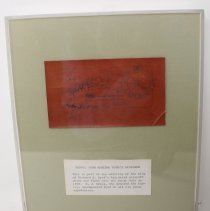
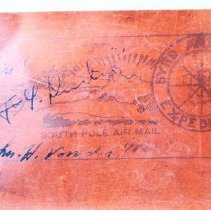
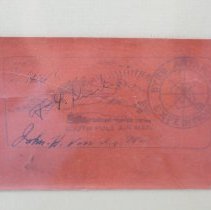
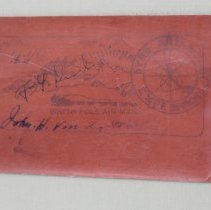
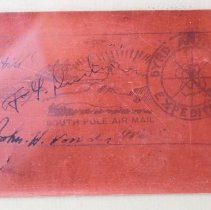
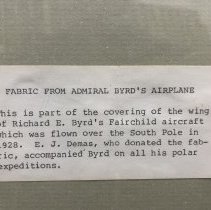
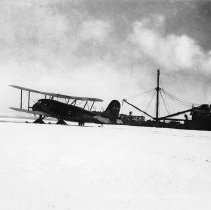
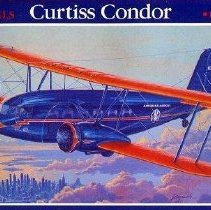
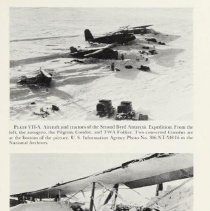
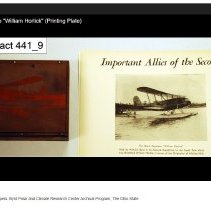
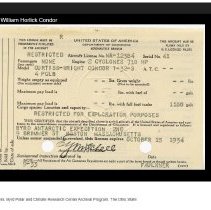
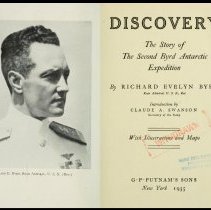
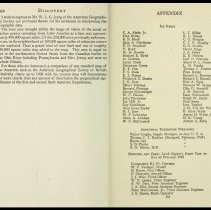
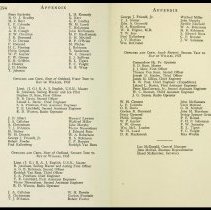
The object is a reddish piece of fabric that measures 3" x 5" and it is stamped with "SOUTH POLE AIR MAIL" and an illustration of the Post Office location also known as "Little America". It is also stamped with a circle with a map of the South Pole in the center and the words around "BYRD ANTARTIC EXPEDITION". It has three signatures in pen appears to be "Joe Hill Jr." or Joseph Hill Jr.; "F.G. Dustin" or Frederick G. Dustin; and "John H. Von Der Wall". A small card in front of the display reads: "FABRIC FROM ADMIRAL BYRD'S AIRPLANE/This is part of the covering of the wing/of Richard E. Byrd Fairchild aircraft/which was flown over the South Pole in/1928. E. J. Demas, who donated the fabric, accompanied Byrd on all his polar/expeditions." Condition: Good, LRC bent . The display frame is in poor condition and the mat board is faded. SPONSOR AN ARTIFACT: Object in need of preservation to be rehoused with in a more stable frame with archival mat board and glass or acrylic with 99% UV Protection. Source: Byrd, Richard Evelyn. Discovery: The Story Of The Second Byrd Antarctic Expedition. G. P. Putnam's Sons, New York, 1935. Appendix. The Curtiss-Wright Condor biplane named "William Horlick" was a key aircraft during Admiral Richard E. Byrd's second Antarctic expedition (1933–35). It was specifically outfitted with skis and floats for operations on ice and snow, and powered by two supercharged Wright Cyclone engines, each producing 725 horsepower. The plane was named in honor of William Horlick, a Racine, Wisconsin industrialist and philanthropist who donated $30,000 to support the expedition. The "William Horlick" made its first flight in Antarctica on December 21, 1933, and conducted extensive exploratory flights, including a significant 6-hour and 43-minute flight on November 15, 1934, which covered 777 miles and photographed new territory in the southeast region, including the Rockefeller Mountains. The aircraft was instrumental in the scientific and geographical mapping efforts of the expedition, with aerial photographer Joseph Pelter capturing key images during these missions. The plane was part of a larger aviation contingent that included a Fokker and a Pilgrim monoplane, as well as a Kellett autogyro for high-altitude reconnaissance. The "William Horlick" was used throughout the expedition until the base camp at Little America II was established, and it played a vital role in advancing the understanding of the Antarctic continent's geography and geophysics. Photograph: Curtiss-Wright Condor biplane named "William Horlick" was outfitted with skis for use during Adm. Richard E. Byrd's second Antarctic expedition, 1933-35. This photo is a copy made by Edward T. Billings; the original photographer is unknown. Image ID:23704 Creation Date: 1938 Collection Name: Horlick's Corporation records, 1873-1974 Original Format Number:PH 4550 Wisconsin Center for Film and Theater Research. Viewed online at https://www.wisconsinhistory.org/Records/Image/IM23704 Joseph (Joe) Hill Jr. was a member of Admiral Richard E. Byrd's second Antarctic expedition (1933–1935), where he served as a cook and later became Admiral Byrd’s personal orderly. He was the youngest man on the expedition at age 20 and was nicknamed "Joe Boy". Upon arriving in Antarctica, Hill worked as a mechanic and tractor driver, helping to unload ships and build Little America II and Byrd’s Advance Base, a remote weather observation hut in the interior of Antarctica. He also contributed to the expedition’s morale by participating in activities such as archery and baseball games, even scoring 340 out of 360 in an archery competition during a temperature of minus 50 degrees. He contributed stories and drawings to the expedition’s magazine, The Barrier Bull. After the expedition, Hill graduated from the University of Texas with a degree in Mechanical Engineering and joined the Douglas Aircraft Group, eventually leading departments including environmental control. He authored a book in 1937 titled In Little America with Byrd: Based upon Experiences of the Fifty-six Men of the Second Antarctic Expedition, aimed at young adults. He was interviewed in 1998 for the documentary Alone on the Ice, reflecting on his time with pride and nostalgia. Hill passed away on October 15, 1999, and his papers were donated to the Polar Archives at The Ohio State University. Source: "Alone on the Ice: Joseph Hill", PBS American Experiences Article, 1998 ©1996–2025 WGBH Educational Foundation https://www.pbs.org/wgbh/americanexperience/features/ice-hill/ Frederick G. Dustin was a key member of the Second Byrd Antarctic Expedition (1933–1935), serving as a fuel engineer and participating in several flights to explore and map large areas, including the Rockefeller Plateau. Commander Fred G. Dustin was a veteran of six polar expeditions, advisor to Admiral Byrd and one of the group which spent the winter of 1934 in Little America on Byrd’s Antarctic Expedition II. Commander Dustin was a member of the U.S. Antarctica Committee and President of the Byrd Polar Center. His logbook from this period, which documents the journey from Boston to the Antarctic via Wellington, New Zealand, and includes daily life on ship and shore, as well as aerial exploration, is preserved in the Dartmouth College Archives. Source: Frederick G. Dustin logbook, Mss-227. Rauner Library Archives and Manuscripts. https://archives-manuscripts.dartmouth.edu/repositories/2/resources/2288 Accessed November 25, 2025. John H. Von der Wall, a life-long resident of Bolton, Connecticut, and master diver in the US Navy, was a tractor driver and the first man to dive under the polar ice. The expedition arrived at Byrd’s post in Little America on January 17, 1934, with 56 men, 147 dogs, 4 airplanes, a handful of snow tractors, and tons of food and supplies. For over a year, the team went on a variety of exploring trips throughout the continent. The extreme cold weather paired with the treacherous icy landscape meant danger on every journey. Von der Wall described an accident that occurred as one of the airplanes took off for an exploration trip: "[The plane] glided and after a short run took off the ice surface….it headed out over the dangerous pressure ridge with its tons upon tons of ice reaching skyward as if trying to grasp this giant bird of mankind and haul it into mighty yawning crevasse, it seemed to grin and mock at is ability to stay aloft. Then the unexpected happened…we saw the giant plane stagger as if hit or grasped by some unseen hands…the camp was alive…men came from everywhere…the pilot was struggling with the controls…the plane was losing altitude fast…the plane headed towards the smooth barrier [of ice] and crashed burying its left wing and part of its motor in the snow." Luckily, nobody was seriously injured in the crash and there were no deaths on the expedition. Despite the difficulties, the explorations were successful, bringing back new information about the landscape, weather, and wildlife of the South Polar regions. Source: "Sixty Degrees Below Zero: Connecticut Man Explores Antarctica" September 15, 2021, By Mike Messina for Your Public Media © Connecticut Public Broadcasting Network and Connecticut Historical Society. All rights reserved. This article originally appeared on Your Public Media. https://connecticuthistory.org/sixty-degrees-below-zero-connecticut-native-explores-antarctica/ Demas, Epaminondas James, (b. Feneo, Corinth, Greece, May 31, 1905-d. November 17, 1979, Los Angeles, California) Other Names: Demas, Pete / Demas, E.J. , aeronautical and flight test engineer, was a member of the First and Second Richard E. Byrd Antarctic Expeditions. He emigrated to the United States in 1917 and settled in Washington. D.C., graduating from McKinley Technical High School in 1926. He received a B.S. in aeronautical engineering from New York University in 1937. During high school, he took instruction in aviation mechanics and flying at Hoover Field in Washington. D.C., and in 1926 was accepted as an aviation mechanic with Byrd’s North Pole expedition to Spitsbergen. During the expedition, Demas took part in preparations for the North Pole flight on May 9, 1926. On his return from the expedition, he was employed by Byrd at the America Trans Oceanic Company at Roosevelt Field, and assisted in preparations for Byrd’s trans-Atlantic flight of the America in 1927. He later joined Dominion Explorers of Canada, but in 1928 was invited to accompany Byrd’s first expedition to Antarctica as an aviation mechanic. He took part in preparations for Byrd’s flight to the South Pole, November 28-29, 1929. In 1933 he returned to Antarctica with Byrd’s second Antarctic expedition. During the expedition he was in charge of mechanical equipment and was a member of the party sent to rescue Byrd at Bolling Advance Base in August 1934. He also took part in seismic studies carried out during the expedition. Following his graduation from New York University. Demas worked for the Dallas Aviation Board preparing a master plan for the improvement of Love Field. He later worked for the Glenn L. Martin and Douglas Aircraft Company before joining Lockheed Aircraft Company in 1940 as a structures test supervisor. Between 1942 and 1943, when he returned to Lockheed, Demas was a flight engineer for Trans-World Airways, ferrying C-54s, 307s, and B-24s along the North and South Atlantic routes. During his thirty years with Lockheed Aircraft Company, he served in a variety of positions. These included flight test engineer, Lockheed representative on the Pan American Airways first scheduled round-the-world flight, consultant to the Navy in the development or ski-equipped P2Y2s, and tests of anti-icing equipment on aircraft. He also conducted tests on flight simulators for the WV-2 and C-212C military Constellations, the SR-71, and was consultant on the Constellation 1049 and 1649 simulators. He retired from Lockheed on May 31, 1970. Among his awards, he received by special act or Congress, the gold medal awarded member of the first Byrd Antarctic Expedition, 1928-1930, and a silver medal awarded members of the second Byrd Antarctic Expedition, 1933-1935. The Demas Ice Tongue and Demas Range in Antarctica were named in his honor. Source Notes: Epaminondas J. Demas personal papers, 1926-1972: National Archives Identifier 18514892 California death index, 1940-1997, via Ancestry.com, May 13, 2015 Washington Post via ProQuest.com, May 13, 2015: article: "E. J. Demas, 19, Immigrant from Greece, is graduate of McKinley High", March 14, 1926 The Ohio State University, Byrd Polar and Climate Research Center Archival Program, University Libraries 134 University Archives 2700 Kenny Road, Columbus, OH 43210 https://library.osu.edu/polararchives.osu.edu Bertrand, Kenneth John. "Americans in Antarctica, 1775-1948". American Geographical Society, 1971. https://archive.org/details/americansinantar0000bert |
Catalog Number |
ME166 |
School Site # |
8080 |
School Name |
Richard E Byrd Middle School |
Dimension Details |
3" x 5" (actual) |
Material |
Fabric |
Caption |
Fabric from Admiral Byrd's Airplane |
Related Publications |
Byrd, Richard Evelyn. Discovery: The Story Of The Second Byrd Antarctic Expedition. G. P. Putnam's Sons, New York 1935. "Alone on the Ice: Joseph Hill", PBS American Experiences Article, 1998 ©1996–2025 WGBH Educational Foundation https://www.pbs.org/wgbh/americanexperience/features/ice-hill/ Frederick G. Dustin logbook, Mss-227. Rauner Library Archives and Manuscripts. https://archives-manuscripts.dartmouth.edu/repositories/2/resources/2288 Accessed November 25, 2025. "Sixty Degrees Below Zero: Connecticut Man Explores Antarctica" September 15, 2021, Connecticut Historical Society, By Mike Messina for Your Public Media. © Connecticut Public Broadcasting Network and Connecticut Historical Society. All rights reserved. This article originally appeared on Your Public Media. https://connecticuthistory.org/sixty-degrees-below-zero-connecticut-native-explores-antarctica/ Epaminondas J. Demas personal papers, 1926-1972: National Archives Identifier 18514892 California death index, 1940-1997, via Ancestry.com, May 13, 2015 Washington Post via ProQuest.com, May 13, 2015: article: "E. J. Demas, 19, Immigrant from Greece, is graduate of McKinley High", March 14, 1926 The Ohio State University, Byrd Polar and Climate Research Center Archival Program, University Libraries 134 University Archives 2700 Kenny Road, Columbus, OH 43210 https://library.osu.edu/polararchives.osu.edu Bertrand, Kenneth John. "Americans in Antarctica, 1775-1948". American Geographical Society, 1971. https://archive.org/details/americansinantar0000bert |
Relation |
Show Related Records... |